Welcome To The
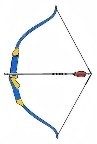
Battle Bow
Bible Teaching Series
by
Kraig Josiah Rice

BOW is an anacronym for Bread On The Waters, the Bible teaching ministry of Kraig Rice. BOW's Bible Doctrine is that of mainline Christianity (Assemblies of God Church denomination).

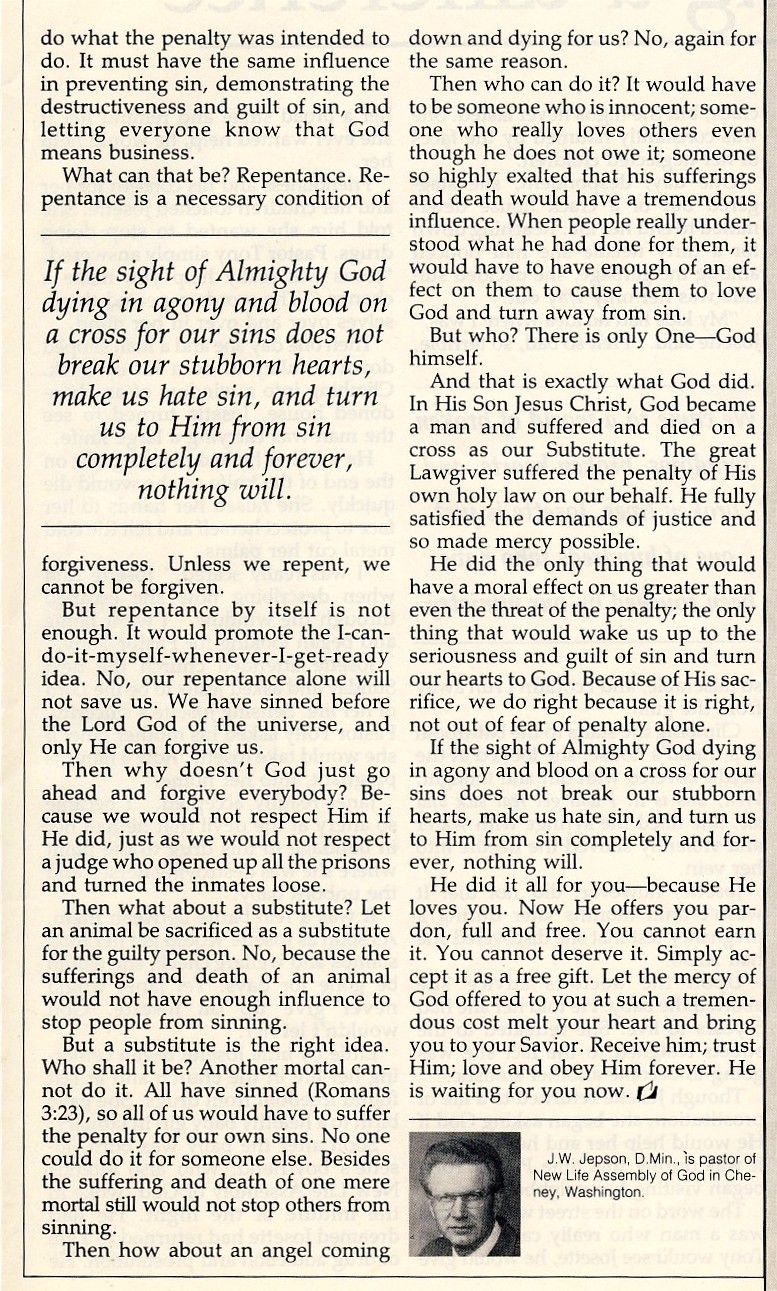
...the war-bow was used in fighting. I use it here to symbolize the Christian's warfare against the world, the flesh, and the devil. Every Christian needs to be armed with the knowledge of the Word of God in order to do battle
(Ephesians 6:17).

"For the LORD Almighty has arrived to look after his flock of Judah; he will make them strong and glorious, like a proud warhorse in battle. From Judah will come the cornerstone, the tent peg, the battle bow, and all the rulers. They will be like mighty warriors in battle, trampling their enemies in the mud under their feet. Since the LORD is with them as they fight, they will overthrow even the horsemen of the enemy" (NLT)
(Zechariah 10:3 - 5).
Links to Bible Study Pages

A Bible Study About Sin
Everything you want to know about sin. Where it came from, how it effects your life, God's remedy for it, and more...

Sanctification
Have you ever wondered why it is not so easy to live the Christian life? You and I need to deal with the depravity in our lives. Here is a bible study on how to keep depravity conquered and, at the same time, live a life of personal holiness to Jesus Christ. Sanctification is a very important Bible doctrine that each of us needs to fully understand so we can lead a life that is pleasing to the Lord.

Obedience To God
If you're a child of the King then you are expected to be obedient to Him. Why? What's it all about?

A Bible Study About Miracles
Do you need a miracle to happen in your life? God still works miracles. Maybe He has one for you...

A Bible Study About Overcoming Discouragement
We all seem to get discouraged from time to time, but what does God have to say about it? You can overcome it. Learn how to do it...

A Bible Study About the trial of your faith
We all go through trials from time to time. Some are harder than others. Do you know how to get through a trial of your faith? Learn what the Word of God has to say about your trial and the best way to make you a conqueror through it.

These are bible studies celebrating our Lord Jesus Christ. These studies are all part of the Biblical subject of

CHRISTOLOGY (The Study of Jesus Christ)

A Bible Study About the Prophecies Concerning Jesus Christ
Jesus Christ appearing on the scene was no accident. His birth, ministry, death, and resurrection were foretold in the Old Testament scriptures. This Bible study should boost your faith. It is important to the Lord that you study these scriptures. However, it is only a portion of the entire study of Christology.

A Bible Study About the Jehovah names attritubed to Jesus Christ
Jehovah names like Jehovah-jireh and Jehovah-nissi refer to Jesus Christ. You are guaranteed to get a blessing from such an in-depth Bible study. However, it is only a portion of the entire study of Christology.

A Bible Study About Jesus Christ
In this study I hope to show you who Jesus is, why He came to earth, what He accomplished while He was here, and what He will accomplish in the future. This study should also reveal why He is worthy of our respect, love, worship, and obedience. Because this page is so large please allow a little extra time for your browser to load this page as well as extra time after you click on the internal links (if necessary). If you have waited a considerable amount of time for this page to load then you might want to download this web page choosing the "html only" option. That way it will load faster while on your own computer's hard drive:)

Book of Revelation Chapters 1 thru 4

The Book of Revelation Chapters 5 through 13

The Book of Revelation Chapters 14 through 22

We don't change God's message
His message changes us

How To Study the Bible
by Jamie Buckingham

"Suppose you are planning a trip. You carefully pack your suitcase, perhaps suspend your newspaper delivery, even get your car checked and gather your family to go with you. You attend to every necessary detail except one: you never pick up a road map.

Because you're in a hurry to reach your destination, you jump in your car and start driving. Which direction do you go: north, east, south or west? Does it make any difference?

Since you feel you're headed the right way, you keep on driving. You are like the bus driver who after a day of hard driving turned to his passengers and said, "Folks, I have good news and bad news."
"The bad news is we're lost and I haven't the faintest idea where we are. The good news is we're making excellent time!"

A lot of people start out on their Christian journey this way. They are so excited about their progress they get lost along the way. They are so intent on reaching their destination they ignore the basic steps they should take to get there. In other words, they ignore the fundamental Instruction Manual, the Word of God, which has the principles by which we live and die.
end of page 117

In this chapter I want to give you some practical, helpful hints on Bible study— which will make the journey much easier.

WHERE DO YOU START?

First, everything you need to know about power for living is found in this Book. In its pages are God's instructions on how to raise your family, how to treat your wife or husband, how you should eat, how you should worship...in short, everything you need to know about money, work, fear, pain, sex, and death. Any problem you can experience has its solution in the Bible.

Start by recognizing that even though the Bible is an entire library of 66 books— it is also one book. In Genesis you find the beginnings, in the Revelation you discover how it all winds up. And from Exodus (the 2nd book) to Jude (the next-to-last book) you see how God carried out His purpose. You cannot dispense with any part of it.

The Old Testament is the foundation; the New Testament is the superstructure. A foundation is of no value unless a building be built upon it. A building is impossible unless there is a foundation— and makes no sense unless there is a superstructure. Thus both Old and New Testaments are of equal value. The Bible is one book, one history, one story. His story. Behind every event stands God, the builder of history, the maker of the ages.
end of page 118

In its original version the books of the Bible were not divided into chapters and verses. Each book was written to be read from beginning to end. God took great pains to give it to us as a progressive revelation of Himself, and you should take great pains to read it from beginning to end. You'll never understand it if you simply open it at random and begin reading.

This does not mean, however, that particular verses or chapters will not become especially meaningful to you. History is filled with stories of men and women who simply opened the Bible, and heard God speaking so profoundly it changed their lives. In the beginning, it may be too difficult to wade through long books and chapters. Verses and sections of verses, especially Psalms and Proverbs, will be meaningful to you regardless of the order in which you read them. This should never suffice, though, for earnest, systematic study of the Bible as a complete unity. Just as you would never dream of going to the library, checking out a book, and begin reading in the middle, so you need to learn to view the Bible as one book.

A LOVE STORY

The Bible is the greatest love story ever written. It is the story of God's love for all mankind— especially you. It is not a book of verses such as you would find on greeting cards; it is a revelation. It must be read, digested, studied, questioned and revered from beginning to end. Don't divide it into short devotional paragraphs and think you can understand its message. Come to its pages with common sense, believe that every book is about something and read and reread until you find out what that book is about.
end of page 119

Since the Bible was inspired by the Holy Spirit, you need the Holy Spirit's power to help you understand it, to interpret it. That is one of the functions of the Holy Spirit— to help you understand the Bible. Therefore, before you begin any serious study of the Bible, ask the Holy Spirit to fill you. Only as He interprets it to you will it make any sense. Otherwise it will be nothing more than great literature, interesting history, or a jumble of words and genealogies.

Are all the books of the Bible of equal importance? No, but all are indispensable. If you were to ask me if my brain is more important than my hand, I would tell you my brain is more important. Yet my hand is important also— and I would have a difficult time without it. So with the Bible. Every book is necessary to make a perfect whole, but some portions are more precious than others. You can't take away the book of Esther or the Song of Solomon and have a perfect revelation of God. Yet no one says either of these two books is comparable with the Gospel of John, or the book of Exodus. All are part of an organism and that organism is not complete if any part is missing.
end of page 120

THE A,B,Cs OF BIBLE READING

How, then, should we begin reading? Why not begin reading the same way you would visit an art museum. Walk with your guide down the long rows of pictures. What do you do? Well, for one thing you don't walk hurriedly. Nor do you carry on a conversation about the stock market or the world series with a friend. You listen carefully to your guide as he pauses in front of each picture. There he describes, not the picture, but the artist. He tells you who the artist was, what he was going through when he painted the picture, where he lived and what he was trying to express through his art. Then he talks about the various art forms. Some paintings are realistic, others are abstract. You need to understand the artist's techniques and style, how he used composition, lights, color, shadows and proportions. Then, finally, the guide will ask you to study the painting itself and see if it has a message for you as an individual.
That's the way you should study the Bible.

Begin With the Author

Studying the Bible is much like learning to interpret art. First, you should know the author of each book. As a writer I have learned, for instance, that those who understand my books best are those who know me. The better you know me the better you understand what I have written.

That's the reason you need to start with the Holy Spirit when studying the Bible. The Holy Spirit worked through every writer of these books, revealing the nature of God. Then you need to learn as much as you can about the human writers. Amos, for instance, wrote the book that carries his name. It is helpful to know that Amos was a farmer, a herdsman, that he lived in a time when the Kingdom of Israel was divided into two nations— a southern and a northern kingdom, much like the United States was divided during the Civil War. Amos lived in the Southern Kingdom called Judah. When he prophesied against the northern kingdom he got a lot of "Amens!" from his southern audience. But when he began pointing out the sins of Judah, they ran him out of town. Knowing this background helps in understanding the content of the book.
end of page 121

Take another case. It is helpful to know that the same man who wrote the Gospel of Luke also wrote the book of Acts. His name was Luke. He was a physician turned biographer. Not only did he write one of the four biographies of Jesus found in the New Testament, but he later traveled with the Apostle Paul and wrote the history of the early church— actually the biography of Paul in a book called Acts. When you discover that Luke was a medical doctor, you can understand why he uses certain language, his close attention to detail, and his many references to physical healings and miracles.

Each writer of the Bible— from Moses to the Apostle John— used a different style. But each was inspired by the Holy Spirit and all he wrote was true and without error. No one writer had a full picture of God, but when their writings are put together you see God in all His glory— in His entirety.
end of page 122

Select a Good Version of the Bible

There are many different versions of Bibles on today's market. Owning a Bible which is easy to read is important for the beginning reader. For years all we had to read was the Bible authorized by King James in 1611. It is a magnificent book with flowing poetic language which has blessed millions of people across the years. But in the 20th century, it is difficult to understand. It is full of "thees" and "thous" and uses many words which are no longer popular.

Most of the scripture used in this book is from the New International Version— which is my favorite. It is easy to read and correctly translated from the original languages.

Others prefer to start with one of the paraphrased translations such as The Living Bible. It is extremely easy to read. When used alongside one of the other newer translations, it makes Bible reading easy and exciting.

Read for the Big Picture

A good practice is to train yourself to read the Bible one book at a time. The first time you read a book in the Bible, try to get an overall feel for what the book says. This is the skyscraper view. Don't worry about details, try to get the panoramic sweep. It's like climbing into a tree to see everything from above.

Start, for instance, with the book of Mark. Mark is easy to read. It is an action book about the life of Jesus, full of stories without too much difficult teaching.
end of page 123

Or you may want to start with Genesis. It's the same kind of book, filled with wonderful history. You probably won't read Genesis all at one sitting, but you can read it by sections. I like to read Genesis as a book of people's lives. That is, I like to see it as a book of biographies of men like myself. So I read about Adam and Eve. Then about Noah. There is a long section about Abraham. Another about Isaac. And finally those thrilling stories about Jacob— who was a man so much like I am. When you view Genesis as a book of stories about people, it is not only easy, but exciting to read.

Do not start in the middle of the Bible with books like Daniel or Isaiah. They simply won't make sense until you begin to get the big picture.

Read for Details

Don't stop with first impressions. Now that you are looking at the Bible from the top of a skyscraper, move on down and get a sidewalk perspective as well. At this point it helps to begin to follow some steps.

(1) Start by reading a book a week. This is not as difficult as it sounds. The longest book in the Bible can be read by spending less than one hour a day. Simply divide the book into seven equal parts, set aside a special time each day to read, and establish a habit of Bible reading.
end of page 124

(2) Use a notebook. Don't just read. Make notes as you do. Underline passages in your Bible that seem significant to you and make notes in your notebook about any questions you may have, or any ideas the Holy Spirit may give you as you read.

I often use my notebook during Bible reading as I do when I pray. I make notes on what God is saying to me. After all, that's why we should be reading the Bible. It is more than God's Word. It is God's Word to ME. Well, if God is speaking to me I'd better take notes on what He is saying. So I nearly always read the Bible with an open notebook— pen ready to jot down God's personal message to me.

Perhaps the most meaningful Bible I have is the one my father used immediately after he received Jesus Christ as his personal Saviour and Lord at the age of 62. My father had always been a good man— an active member of the church. But it wasn't until he went through a deep, personal trauma that he surrendered his life to Jesus Christ. Immediately he began an intense study of the Bible. He wanted to know what God was saying to him. He began by using a modern translation. Not only did he read, but he underlined, using different colors for different emphasis, and he made many notes in the margins of the Bible. It is these notes, along with his exclamation points, question marks and stars which helped guide me through my own initial Bible study three years later when I, too, received Jesus Christ as my Saviour and Lord.
end of page 125

Writing does something for the mind. Simply putting thoughts on paper helps record them in your brain. I love to see people taking notes in church for future reference. I recommend you make notes directly on the pages of your Bible. When that Bible is full, go to another.

You also might want to record your personal paraphrase of the passage you're studying. How does it translate into your life? A paraphrase is rewriting the Scripture in your own words. You'll be astonished at the results. It will make you study aspects of the verse of which you weren't aware. Also, it will help you remember what the passage says.

(3) Read devotionally. I recommend you read the Bible seriously, as you would study a book. But in order to get the most out of the Christian life you should read it devotionally— believing God will give you hidden nuggets of gold as you dip your pan into its stream.

Let me give you an example of this in my life several years ago.

One day I was alone in our little cabin in the Blue Ridge Mountains of North Carolina. It was just a few weeks after my father had died. I had come to the cabin without my wife or children to work my way through my grief. One afternoon sitting in an old rocking chair on the front porch, looking out at the brilliant autumn colors sprinkled across the mountains, I opened my Bible to the Twenty-third Psalm— an old favorite. I read it through casually, but my eyes stopped and rested on verse four: "Thy rod and thy staff they comfort me."
end of page 126

The property where our mountain cabin is located had been developed by my father over the last 40 years. He had the land cleared, had a stone mason come in and build the rock wall beside the driveway, and had worked with our old friend and neighbor, Raymond Cox, to build the cabins. He loved this place and would come up during the hot summer months to escape the Florida heat. He also loved to come up in the autumn to sit on this porch, rock in this chair, and enjoy the beautiful colors of nature. Everywhere I looked I saw my father's signature on the property.

I glanced up from my Bible, blinking back the tears of grief, and saw— standing in the corner of the porch— my father's favorite walking stick. He had carved it out of a crooked rhododendron branch. Although it looked much like an Irish shillelagh, I saw it as something far more. I could still hear my father that day when I was a sophisticated sophomore in college— still far from the Lord. Daddy, who had surrendered his life to Jesus Christ the summer before, had finished carving and sanding on the walking stick. Holding it up for me to see, he grinned and said, "From this time on, every time you see this old stick, you will be reminded that it is God's rod and God's staff which brings you comfort."

Suddenly the grief was gone. In its place was the Presence of God.

Read devotionally, and let God meet you at your place of greatest need— perhaps through a simple verse and a small reminder at your elbow.
end of page 127

(4) Ask questions. The Bible is not so sacred that it cannot stand honest examination. Ask when a thing took place. Ask why it was included in the Bible. Ask where it happened. Ask who was writing, who it was written about and to whom was it written. Ask what it meant at that time and what should it mean to you. Don't be frustrated if your study raises more questions than you can answer. You are dipping into a great well of spiritual knowledge that has no limits but will quench all thirst.

(5) Respond. Bible study is not an end. It is the means to an end. Many people have studied, even memorized the Bible, but have not responded personally to its call on their lives. The reason we study the Bible is so we can discover God's will for our lives— and apply it. Your study will uncover many things God wants you to do. But unless you respond, all your Bible study will be meaningless.

I once read of a mule standing exactly between two identical hay stacks. He was extremely hungry, but the poor animal stood there and starved to death because it never could make up its mind from which stack to eat.

Often we find ourselves in the same position as that mule. We read the Bible and in it we find God's will for our lives. But since that will usually is in conflict with something else going on in our lives— we simply stand still where we are...and starve to death.
end of page 128

The Swedish Nightingale, Jenny Lind, whose real name was Goldschmidt, won great success as an opera singer. She was at one time the richest and most famous singer in the world. Then one day, at the height of her fabulous career, she left the stage and never returned— choosing to live in privacy.

One day an English friend found her sitting on the steps of a small beach cottage watching a magnificent sunset over the ocean. On her knee was an open Bible. They talked and eventually the English woman asked the inevitable question. "Madam Goldschmidt, how is it that you came to abandon the stage at the very height of your success?"

The famous singer answered quietly. "When every day it made me think less of this," she said, laying her hand on the Bible, "and nothing at all of that," and she pointed to the sunset, "what else could I do?"

Jenny Lind did more than read her Bible. She responded to its call on her life as well.

(6) Memorize your Bible. Nothing will make the Bible a part of you as much as memorizing verses. "I have hidden your word in my heart," the Psalmist said, "that I might not sin against you"
(Psalm 119:11). Remembering that Jesus Christ is the "Word," and it is His presence which keeps us from sinning against God, nevertheless memorizing Scripture and hiding it in our hearts keeps the Presence of Christ fresh.

Prisoners of war in North Vietnam brought back stories of how they had pieced together all the verses of scripture they had memorized to form a partial Bible. It was these verses which helped some of them make it through those horrible years of imprisonment.

My mother and father established a pattern of Bible memorization which they carried on for years— committing one verse a week to memory. I know others who memorize a verse a day. Some people choose to memorize entire chapters at a time. A friend keeps Bible verses, written on little cards, above the sun visor of his car. When he is waiting at a traffic light, he flips down the sun visor and works on his Bible memorization. I have another friend, a jungle pilot who flies missionaries over the vast expanses of the Amazon jungle in small airplanes. He studies his scripture cards as he flies. A famous Bible teacher testifies that memorizing portions of the Bible was the secret to his overcoming an "uncurable" learning disability. Another says memorizing passages from the Bible helped him overcome stuttering.
end of page 129

"Your word is a lamp to my feet and a light for my path," David said
(Psalm 119:105). Hide it in your heart and it will bring inner light as well.

(7) Use Bible helps. There are a number of good books which will help you study the Bible. Keep in mind that no book about the Bible is as good as the Bible itself, but the use of study aids will make things easier. Here are some books which you will want to get to help you along.

Concordance. A concordance is a book that lists all the words of the Bible and all the places that word is used. For instance, let's say you remember there is a verse of scripture someplace in the Bible that talks about "the valley of the shadow of death." Go to your concordance and look up the word "valley" or the word "death" just as you would look up a word in the dictionary. You will then find several scripture references after each one. With "valley" you'll find a number of references. The Bible talks about a "valley of dry bones" in
Ezekiel 37:1, about a "valley of decision" in Joel 3:14, and about the "Lily of the Valley" in
Song of Solomon 2:1. But if you keep checking you'll find a reference to "the valley of the shadow of death" in
Psalm 23:4.

end of page 130

I recommend you start with a simple English concordance such as Cruden's Complete Concordance to help you trace words in the Bible.

Bible Dictionary. A Bible dictionary is a cross between a dictionary and a one-volume encyclopedia. It is a collection of articles explaining places, people and other subjects of the Bible. One of the best is the New Bible Dictionary.

Commentaries. A commentary is a running explanation of the Bible chapter by chapter (sometimes verse by verse). It explains what the text is about. Commentaries come in many-volumed sets with comprehensive explanations of each verse of scripture, to the more simple one-volume kinds. A fine one-volume commentary is the New Bible Commentary.

Bible Aids. There are numbers of books about the Bible. I recommend you visit a good Bible and book store in your city and ask the clerk to show you around. You'll be amazed at the vast collection of books, Bible atlases, maps and study guides available. They may also recommend to you a good Bible correspondence course which you can enroll in as a more serious Bible student.
end of page 131

A final word is important. While it is good to read the Bible alone in a "quiet time," it is exciting to study it as part of a group. There are thousands, indeed tens of thousands, of Bible study groups around the nation. Many of these are part of Bible-believing churches. Studying the Bible as a member of a group allows you to have access to what the Holy Spirit is teaching others. It will also help keep you from developing wrong interpretations. Therefore, even though I recommend private Bible study as part of your daily life, I hope you will find a small group of people— either a Bible study group which meets some evening of the week or perhaps a Sunday school class in a nearby church— and begin studying together with others who are also eager to learn more about power for living through Bible study.

Above all, I hope you remember that it is not the Bible but the Author of the Bible with whom you need to have fellowship. It is said that Gainsborough, the artist, longed also to be a musician. He bought musical instruments of many kinds and tried to play them. Once when he heard of a great violinist who brought ravishing music from his instrument, Gainsborough bought the violin on which the master played so beautifully. Surely, he thought, if I have that wonderful instrument I will be able to play too. But he soon learned that the music was not in the violin, it was in the violinist.

There is an old story of two men who were called on, in a large classroom, to recite the Twenty-third Psalm. One was a published orator trained in speech technique and drama. He repeated the psalm in a powerful way. When he finished, the audience cheered and even asked for an encore that they might hear his wonderful voice again.
end of page 132

Then the other man, who was much older, repeated the same words— "The Lord is my shepherd; I shall not want..." But when he finished, no sound came from the large class. Instead, the people sat in a deep mood of devotion and prayer.

Then the first man, the orator, stood to his feet. "I have a confession to make," he said. "The difference between what you have just heard from my old friend, and what you heard from me is this: I know the Psalm, my friend knows the Shepherd."

That, my friend, is power for living."
end of page 133

Quoted from Jamie Buckingham, Power For Living, Chapter Six, Making The Bible A Part Of Your Life, Arthur S. DeMoss Foundation,November 1983, pages 117-133.
This is a very good book and I recommend that you purchase it if you can find it...

"The Word of God is sharper than any two-edged sword." Hebrews 4:12

As I was preparing this web page at 10:40 am on the morning of June 22, 2007, I was surrounded by the fragrance of the Lord. He paid me a visit but not visually. I smelled His fragrance- like the scent of lilacs. His scent filled the room where I was working. I raised my hands and worshipped Him. He is very kind and very encouraging. And much the opposite of the smell of demons who smell like manure...who also pay me visits from time to time to torment me.
- Written by Kraig J. Rice.

Take A Look   

OR

The Christian Counter


June 23, 2007